
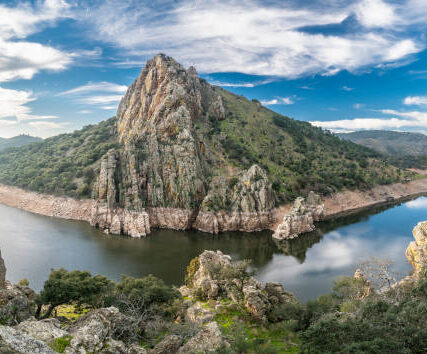
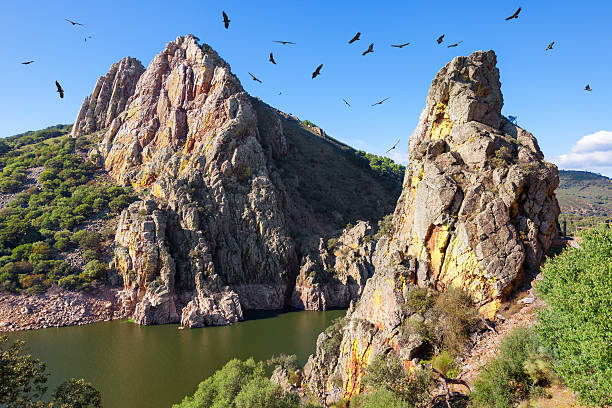
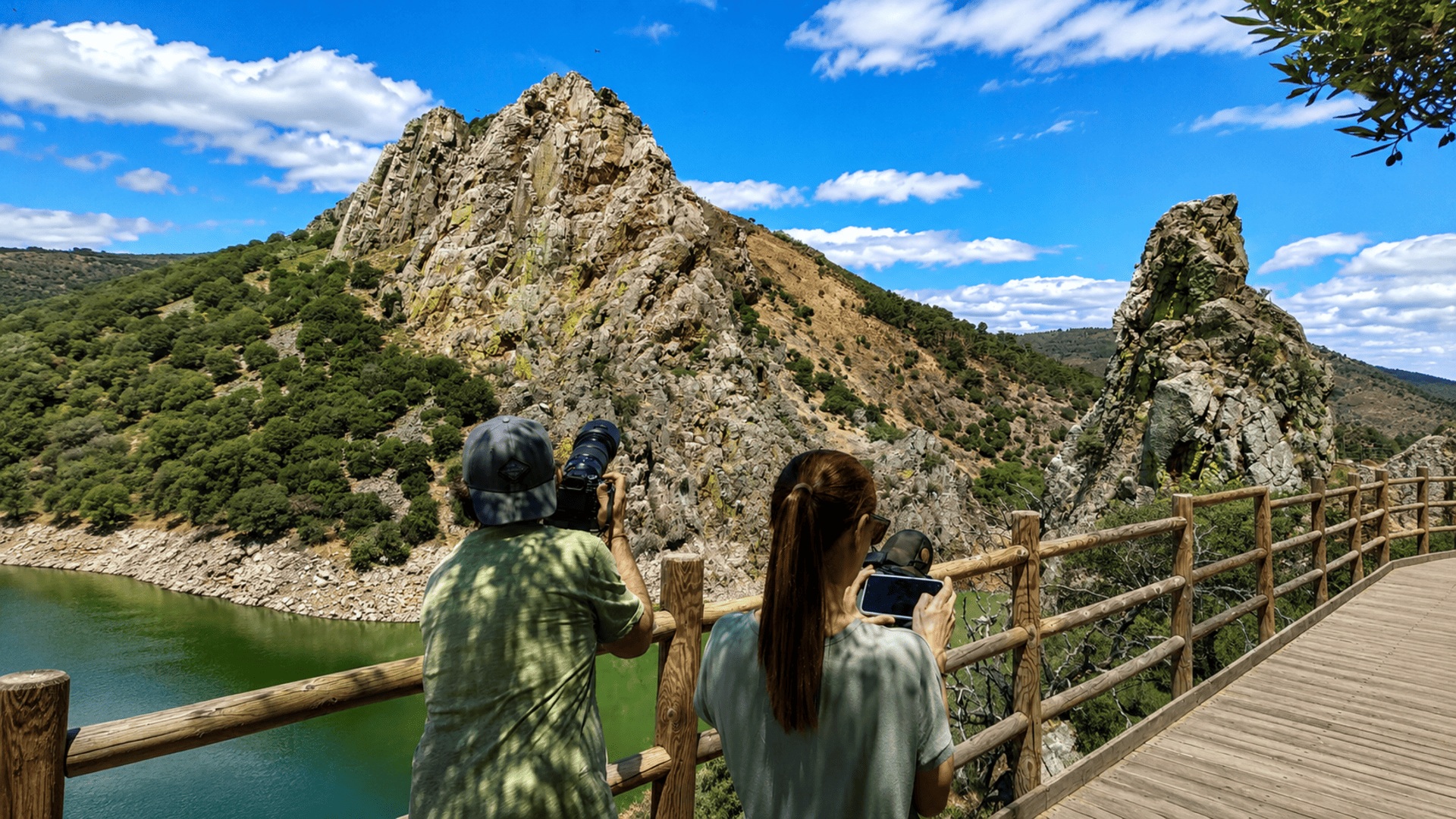
Salto del Gitano is one of the best-known and most spectacular places in Monfragüe National Park. Opposite the viewpoint rises Peña Falcón, an enormous quartzite cliff dropping towards the Tagus River and providing shelter for numerous bird species.
The combination of rock, water, Mediterranean forest and wildlife makes this one of the most representative landscapes of Monfragüe. It is also one of the best places in the park to stop, take out your binoculars and watch the constant movement of birds around the cliffs.
Tip: bring comfortable footwear, water and binoculars to make the most of the views and wildlife.
A landscape that defines Monfragüe
The great protagonist of Salto del Gitano is Peña Falcón, an impressive rock wall rising beside the Tagus River.
These quartzite formations are among the most characteristic geological features of the park. Over millions of years, erosion has shaped these immense cliffs, while the most resistant rocks have remained standing to form the rugged relief that now defines much of the Monfragüe landscape.
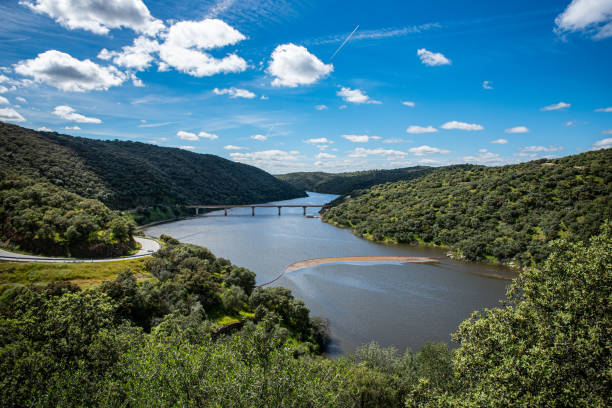
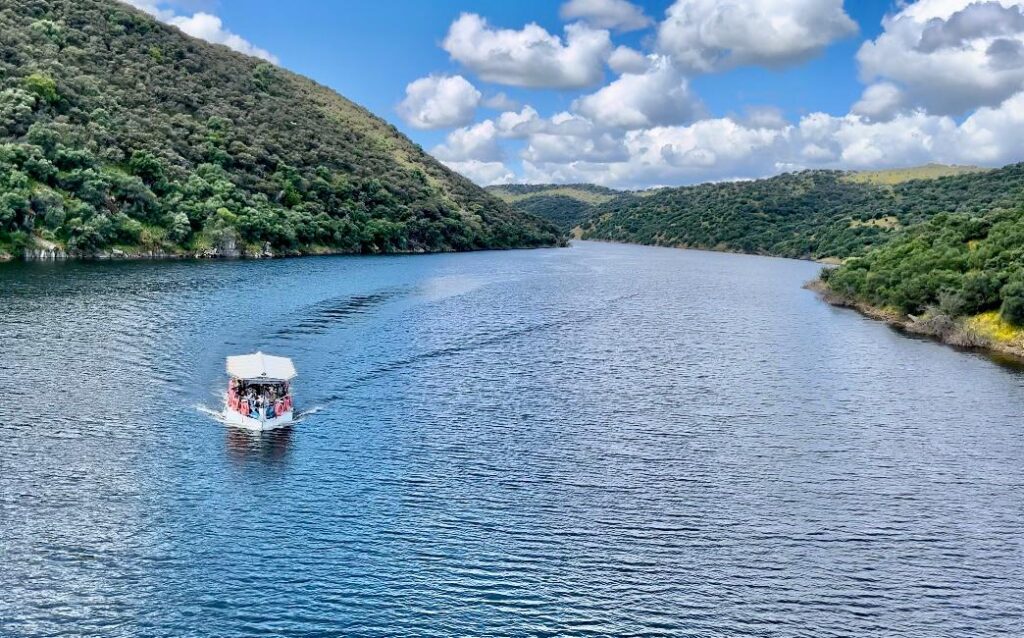
From the viewpoint, the relationship between the river, the cliffs and the Mediterranean forest covering the hillsides can be clearly appreciated.
One of the best places for birdwatching
Salto del Gitano is one of Monfragüe’s most important birdwatching locations.
Opposite the viewpoint is one of the park’s largest colonies of griffon vultures, and it is common to see dozens of birds resting on rocky ledges or using the rising air currents to soar above the valley.
But they are not the only stars of the show. Other emblematic species can also be seen here, including black storks, Egyptian vultures, cinereous vultures and several species of eagles.
The legend of Salto del Gitano
The name Salto del Gitano is linked to a well-known local legend from Monfragüe.
According to tradition, a young Roma man pursued by the Spanish Civil Guard managed to escape by leaping from one side of the gorge to the other, leaving his pursuers astonished by the incredible distance of the jump.
As with many popular legends, there are several versions and it is not a documented historical event. Nevertheless, the story has remained forever associated with the name of this iconic place.
Tips for visiting Salto del Gitano
Bring binoculars. Although many birds can be seen with the naked eye, binoculars greatly improve the experience.
Take your time. Spending a while watching the cliffs increases your chances of spotting different species.
Look at the sky too. Don’t focus only on the rocks: many birds of prey appear soaring high above the viewpoint.
Keep quiet. It makes the experience more enjoyable and avoids unnecessarily disturbing the wildlife.
Stay within the designated areas. There is no need to approach the cliffs to enjoy excellent views.
Salto del Gitano or Portilla del Tiétar?
Salto del Gitano offers a more monumental view, with Peña Falcón dominating the landscape and large numbers of griffon vultures.
Portilla del Tiétar is smaller and quieter, with the rock walls closer to the viewpoint and excellent opportunities to observe other species.
If you have enough time, both viewpoints are well worth visiting.